Short answer? Yes, even small business owners need a marketing funnel. But not the overwhelming, 37-step kind that makes you want to throw your laptop out the window.
But what is a marketing funnel? Simply put, a marketing funnel is just a way of describing the journey your audience takes—from discovering your brand, to getting curious about what you do, to finally hitting “buy now.” These steps are often referred to as marketing funnel stages, and understanding them helps you create content that actually moves people toward a decision instead of leaving them stuck at “just browsing.”
That’s it.
It’s not a complex tech setup or a bunch of jargon-y steps. It’s just a framework that helps you stop throwing spaghetti at the wall and start guiding people from “Who are you?” to “How do I work with you?”
And if you’ve ever found yourself posting consistently but still not making sales, wondering why your email list is growing but your revenue isn’t or hearing “I love your content!” with zero follow-through? Then yes, you need a marketing funnel.
But don’t worry, we’re keeping it simple here. In this post, we’re breaking down:
- Exactly what a marketing funnel is
- Why you need a marketing funnel even as a small business
- 3 steps to building your marketing funnel
What is a Marketing Funnel? And Why it Matters (Even If You’re Not a “Marketing Person”)
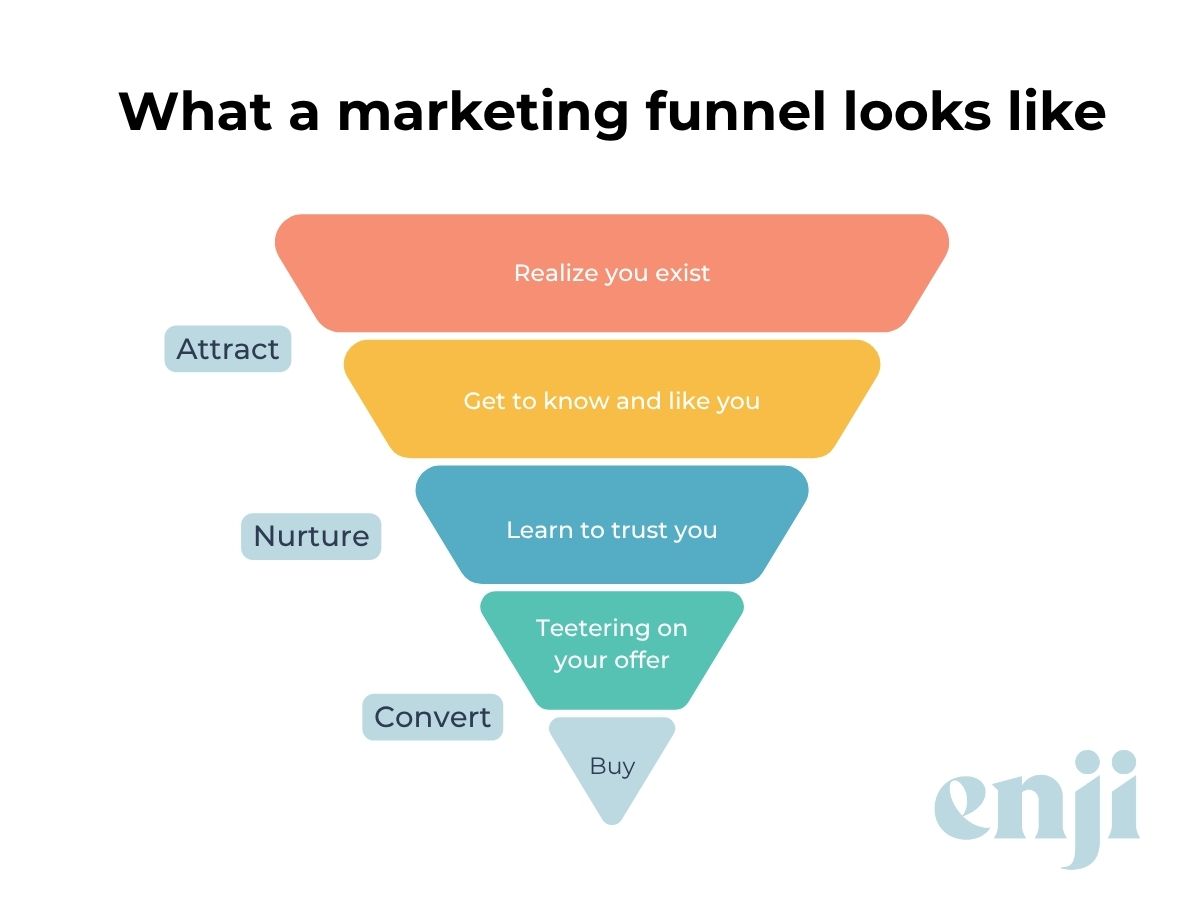
We’ve already talked about what a marketing funnel is: a marketing funnel is just the path someone takes from discovering your business → getting to know you → becoming a paying client or customer.
And the reason it’s called a “funnel” is that at each stage the pool tends to get smaller and smaller. As your potential client works their way down the marketing funnel stages, it’s normal to see some drop-off. The amount of people who know you exist will always be larger than the amount of people who buy from you (don’t shoot the messenger).
And truthfully, if you’ve ever felt like your marketing is a whole lot of effort with very little return, that’s often where looking at your marketing funnel comes in. Cuz you might have a leak in it.
Without a marketing funnel that works, you might do things like:
- Post random content with no clear strategy
- Get ghosted in your DMs after “I love your work!”
- Grow your email list…but not your sales
- Feel like you’re doing everything right but getting nowhere
That’s why having a marketing funnel is so important.
And the good news is that with even the most simple funnel in place, you’ll be able to see exactly where people are dropping off, so you can fix what’s not working.
Build a Simple Marketing Funnel With Enji
Now that we’ve talked about the fact that you need a marketing funnel even as a small business, let’s walk through how to build one that includes each of the marketing funnel stages.
Step 1: What are you doing to attract people?
This is the top of your funnel. Because the first goal is to make sure people know you exist (that’s what marketing is) and start paying attention. And regardless of how much time you spend each week on marketing, this is where you want to start.
Here’s an example of how to market your small business to attract people:
- Write helpful blogs that are optimized for SEO so people can find you and the internet can refer you
- Post 2–3 times per week on Instagram, TikTok, or Linkedin (pick the platform where your people already hang out)
- Pin content on Pinterest because it’s its own search engine people use to find things
The goal here isn’t to go mega-viral—it’s to be discoverable and memorable. You’re creating that first breadcrumb that leads people into your world.
Focus on clarity, not conversion. Awareness-stage content should answer common questions, name pain points, and explain problems — without pitching your offer. If someone finishes your content thinking, “This explains exactly what I’m dealing with,” you’re doing it right.
Pro-tip: Use Enji’s AI Copywriter, Blog Repurposing Tool, and Social Media Scheduler to get this done quick!
Step 2: What are you doing to nurture people?
Once someone finds you, the next step is to keep them engaged and build enough trust that they want to stick around (and eventually buy).
This doesn’t mean you need to start writing long weekly newsletters or launching a full-blown content series. It just means showing up in small, meaningful ways that remind your audience why you’re the one they want to work with.
Here’s an example of how to market your small business to nurture people:
- Send one email per week (even if it’s just a quick behind-the-scenes, a personal story, or a helpful tip)
- Keep showing up on social media because consistency helps build trust
- Consider being a guest on podcasts or starting your own. Letting people hear your voice and longer form thoughts is clutch
This is where repetition matters. You’re reinforcing the same core ideas from different angles — sharing examples, stories, and context that help people connect the dots. You’re not trying to convince. You’re helping someone feel confident that you understand their situation.
Pro tip: If you’re still growing your email list, focus on adding a call-to-action to your social media posts (think: “Join my list for early access,” “Sign up to get this guide,” etc.).
At the end of the day, nurturing isn’t about selling. It’s about staying top-of-mind before someone’s ready to buy. You’re building the relationship now, so conversion feels natural later.
Step 3: What are you doing to convert people?
This is the part where all that visibility and trust pays off—literally.
But that doesn’t mean you need to shout “BUY NOW!!” or launch an elaborate sales campaign. You just need to make your offer clear, timed well, and easy to act on.
Here’s are some tips to improve this part of your marketing funnel:
- Choose one clear offer to focus on. This could be a product, service, seasonal promo, or upcoming booking window
- Talk about how it helps (not just what it is). Why now? Why them? Why this?
- Add urgency in a way that feels honest and natural (deadlines, limited spots, or seasonal relevance all work)
- Track your marketing metrics so you know what’s working (and what to repeat next time)
At the conversion stage, clarity beats creativity. People don’t need more inspiration—they need direction. Your content should clearly explain what you offer, who it’s for, and what the next step is.
Selling doesn’t have to feel awkward or pushy… especially when you’ve already built the connection. With each of the marketing funnel stages in place, your content does the heavy lifting.
Pro-tip: Enji’s KPI Dashboard automatically tracks most of your marketing metrics for you and turns your numbers into charts and graphs that are easy to understand!
How the Marketing Funnel Stages Work Together
Let’s walk through a real-world marketing funnel example so you can see how the marketing funnel stages actually work together in practice for small business owners.
An Example Of A Marketing Funnel For a Service Provider
Imagine you’re a service provider (photographer, designer, coach, planner, etc.) who books clients on a rolling basis.
Early Funnel Example: Attract Stage
This is the first of the marketing funnel stages, where people discover your business.
Someone searches Google or scrolls social media and comes across:
- A blog post answering a common question in your industry
- A social post that clearly names a problem they’re experiencing
- A helpful resource that explains their options
They don’t inquire yet. They just think:
“Oh—this person understands what I’m dealing with.”
That’s awareness doing its job.
Middle Funnel Example: Nurturing Stage
Next comes the nurturing stage of the marketing funnel.
After that first interaction, they might:
- Read another blog post
- Follow you on social media
- Join your email list to get more behind-the-scenes takes or education
At this point, they’re learning:
- What you specialize in
- How you think about their problem
- Whether you feel like the right fit
This is where consistency matters more than volume. You’re building familiarity and trust—not pushing for a sale.
End Funnel Example: Convert Stage
This is the final stage of the marketing funnel, where action happens.
Now, when the timing is right, they see:
- Content explaining your offer clearly
- A call-to-action to inquire, book, or buy
- Messaging that reassures them they’re making the right decision
Because the earlier marketing funnel stages did their job, this step feels natural—not forced.
They click, then inquire and convert.
How Do I Write Content for Different Stages of the Buyer’s Journey?
At this point, you might be thinking, “Great, I understand the marketing funnel example, but how do I write content for different stages of the buyer’s journey?”
Whether we like it or not, most of your audience isn’t moving through your marketing funnel stages in a straight line. Someone might find you on Instagram today, open your email next week, and finally check out your services a month later. You don’t get to control the exact order—or which piece of content they see first. But what you can control is having the right mix of content in the right places.
That’s why it’s so important to create content for every stage of the buyer’s journey—not just the one you’re focused on right now.
Depending on your marketing strategy, each platform may serve a slightly different role. You might see patterns like:
- Social media is great for visibility and quick-hit awareness
- Email builds trust and keeps you top-of-mind over time
- Your website or blog often supports conversion and decision-making
When you have content that supports each stage—awareness, nurture, and conversion—you’re able to meet people wherever they are in the process.
The goal isn’t to post everything everywhere all the time. It’s to make sure that wherever your audience finds you, they can find the content that moves them one step closer to a decision.
And when you’re using a platform like Enji to help plan, write, and schedule that content? You’re not guessing or scrambling—you’re carefully moving potential buyers through the different marketing funnel stages.
Ready to Build a Marketing Funnel That Actually Works (And Is Sustainable For Small Business Owners)?
You don’t need a fancy setup or a full-time marketing team to turn interest into income. You just need a simple plan—and the right tools to help you follow through.
And the best part? You can start building your funnel inside Enji today—no tech headaches, no guesswork, and no pressure to be perfect. You can even join us at twice monthly office hours whenever you get stuck!
Start your free trial now, and let’s make your marketing actually work for your small business.
.avif)
Tayler Cusick Hollman
Enji Founder and Small Business Marketing Expert
Tayler is one of the Founders of Enji (marketing tools for small business owners who need to plan, do, and review it themselves). With over a decade of marketing experience, she has helped thousands of small business owners create simple marketing plans that help them get results. When she isn't thinking about how to solve the "I do my own marketing" problem, you'll find her skiing, mountain biking, or climbing rocks somewhere.
Try Enji's marketing tools for small business owners for free at enji.co