
ChatGPT ads are the shiny new thing in paid marketing, and if you run a small business (especially one like ours in B2B SaaS), someone has probably already asked if you're on it. We've been running real experiments with real budget, so instead of another "AI is changing advertising forever" post, here's what we actually saw, what the platform can and can't do right now, and how to decide whether it deserves your money.
Short version: the clicks are there, the buyers aren't (yet - at least in our test), and the platform has some quirks nobody warns you about. Let's get into it.
Who actually sees these ads
Start here, because everything else flows from it. Ads only show to people on ChatGPT's Free plan and the $8/month Go plan. Anyone on Plus, Pro, or a business plan never sees an ad. Neither does anyone under 18.
And to be clear on what Go is: it's more ChatGPT, still with ads. Go users get about 10x the message limits and file uploads of the free tier, but removing ads isn't part of the deal. The ad-free experience starts at Plus, at $20 a month. This is an important thing to note.
Think about what that means. OpenAI effectively charges its most valuable users for the privilege of never seeing your ad. The people who happily pay for tools they value, the exact people most likely to pay for your product, have priced themselves out of your reach. Your ads run in the pool of people who either pay nothing or won't pay $20 to make ads disappear.
For us, that math doesn't work. Enji's customers are small business owners who invest in tools that save them time (big realization for us). Your situation may be different, but do this audience check before you spend a dollar. It's the single biggest factor in whether this platform can work for you.
What we saw: lots of clicks, few conversions
Here's the result that surprised me most. Our click-to-conversion rate on ChatGPT ads came in worse than Google Ads.
You'd expect the opposite. Someone deep in a conversation about their marketing problems should be a higher-intent click than someone typing three words into a search box. That's the entire pitch for this platform and AI search in general. In our experiments so far, it hasn't played out that way. Plenty of curiosity, not a lot of buying. My read is that this comes back to the audience, not the ad format.
And before anyone says "that's just an attribution problem": we capture UTMs on first arrival with our own tracking, so even if someone clicked our ad, left, and came back later through a branded Google search, we'd still credit ChatGPT Ads for the introduction (different than ChatGPT organic). The one thing we can't see is people who saw the ad, never clicked, and showed up later some other way… maybe through a branded search. That group is invisible to every advertiser on every platform. The clicks we can measure, we measured honestly, and they converted worse.
What it actually costs to find this out
Here's something the "it's cheap while it's early" crowd skips over: campaigns have a $25 per day minimum. That's $750 a month just to have an experiment running, and realistically you need 30 to 60 days of data before you can conclude anything. So the real entry ticket is $750 to $1,500 in tuition before you know whether the audience even fits your business.
Compare that to Google, where you can poke around at $5 a day. The individual clicks on ChatGPT may be underpriced right now, but the experiment isn't. If $750 a month is a meaningful chunk of your marketing budget, and for a lot of small businesses it is, that changes the calculus.
What you can't control, and what you can't see
A few things to walk in expecting:
You can't define your audience. You can upload a customer or email list, which is fine for retargeting or suppression, but there's no way to say "show my ad to small business owners or solopreneurs" or target by role, company size, or anything demographic. Targeting today is context hints (topics you want to appear near), geography, and platform. That's the whole toolkit. And remember, uploading a list only helps for the slice of your list that happens to be on the Free or Go plan, which for a business audience may not be much. Real audience definition would change everything here, and I have to believe it's coming. It isn't here today.
You can't see what's working. There's no equivalent of a search terms report. You'll never see which conversations triggered your ads or what people were actually asking about. That's a deliberate privacy design on OpenAI's part, and I respect the principle, but as an advertiser it means the optimization loop you rely on in Google Ads simply doesn't exist. You set your context hints and hope with no view into what is actually working and getting clicks. Paying a $750 monthly minimum for a platform that won't show you what resonated is a tough combination.
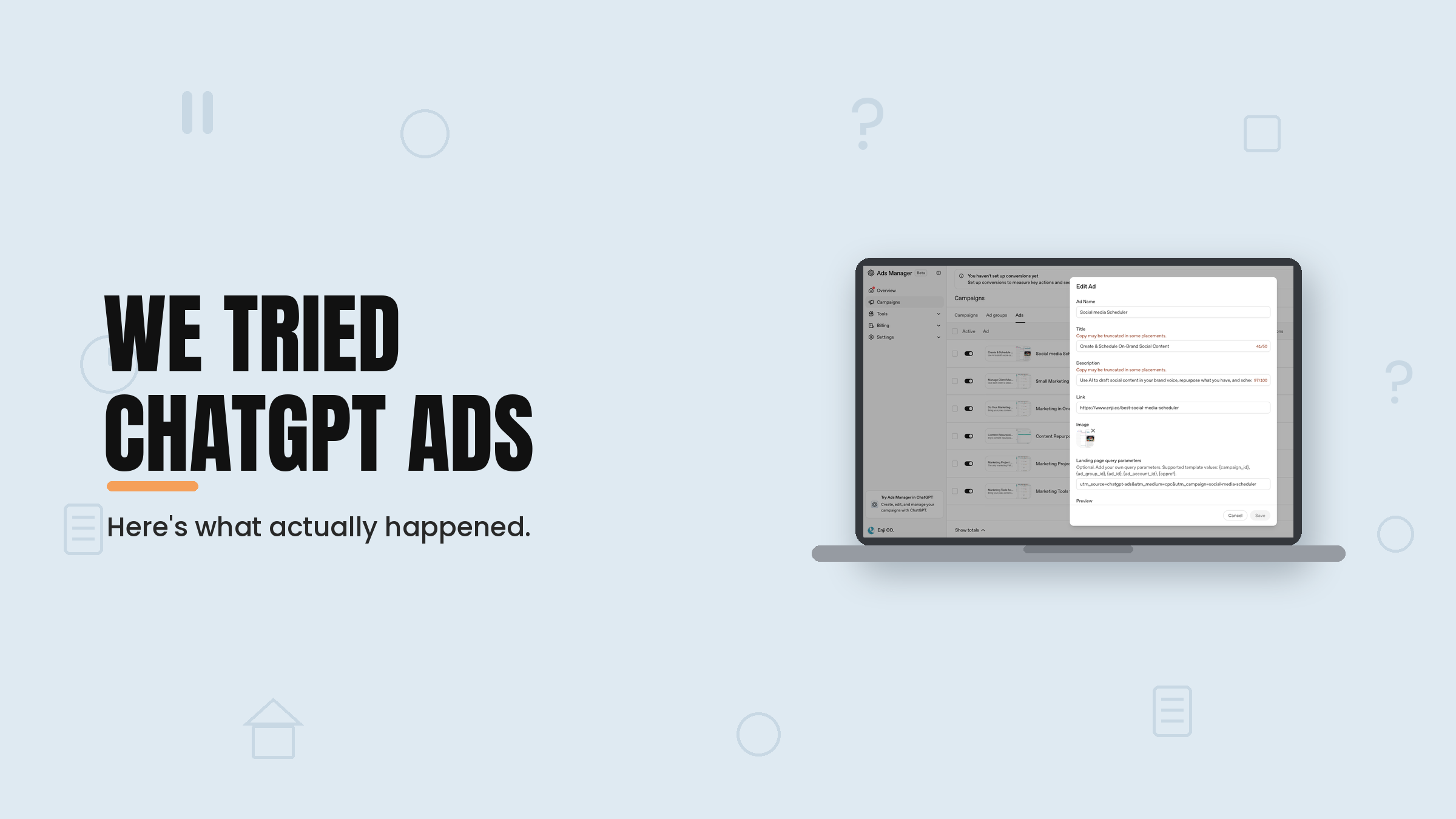
Your ad copy gets cut in half. The ads manager accepts a 50-character headline and a 100-character description. What actually renders on the card truncates around 24 and 48 characters. Nobody tells you this. Write your ad as if you only get the first 24 and 48 characters, because that may be all anyone sees, and treat the rest as bonus.
Why I'm still paying attention
None of this is the final word, because the platform is shipping features at a super fast pace. Audience list uploads just landed. Automated bidding just landed. Better conversion reporting just landed. The version of this platform a year from now will look nothing like today's, and the moment they add real audience definition, I'll be back to check it out.
The early-bird logic is real too. Attention on new platforms is always underpriced before the crowd arrives, and whoever cracks this first in their category gets the worm (this was true with Facebook Ads). I'll just be honest… we haven't cracked it for our audience yet, and the $25/day floor means testing isn't free.
The channel nobody's charging you for
One more thing, and for most small businesses I think it's the bigger opportunity. Ads only reach Free and Go users. But when ChatGPT's actual answer mentions or recommends your business (or Claude, Perplexity, or Gemini), that answer shows up for everyone, including the Plus and Pro subscribers your ads can never touch. The paid channel is structurally locked out of the highest-value audience. The organic one isn't.
There's also only one sponsored slot per response. You're in it or you're absent. The answer above your ad, meanwhile, might be recommending your competitors for free. Showing up in the answers themselves costs nothing but effort, and it's where we've been putting most of ours.
Should you try it?
A quick gut check before you spend:
- Does your ideal customer plausibly use free or cheap-tier ChatGPT? Be honest with yourself here.
- Can you afford $750 to $1,500 to run a real 30-to-60-day test, and treat it as tuition if it fails?
- Can you live without knowing which conversations your ads appeared in?
- Do you have the patience for a beta? Features change weekly and things break.
If these make sense to you, run a capped test and learn the platform while it's uncrowded. If your customers are the kind of people who pay for good tools, like ours are, your money is probably better spent elsewhere for now, and your effort is better spent becoming the answer instead of the ad next to it.
We'll keep experimenting, and as we see things change, I'll write the update.