Booking season gets a lot less stressful when you run it in three stages: a plan up front, a few numbers to watch as inquiries come in, and a debrief once it wraps. Before the season, write down your hypotheses (like “Instagram is my best source of leads”), set your targets by working backward (15 weddings at a 25% conversion rate means 60 inquiries, or about 12 a month over five months), add a required “How did you hear about us?” question to your inquiry form, and log your leads in Enji. During the season, set aside a monthly KPI day to check inquiries against your target, inquiries by source, your conversion rates, traffic-to-inquiry rate and cost per lead. After the season, find your top content, compare lead sources by conversion rate instead of volume, look at where leads went cold, and check which hypotheses held up.
If you’re a wedding pro, does your booking season game plan look a little like this? Post more on Instagram. Say yes to a feature or two. Maybe throw some money at a listing ad. Then…wait and see.
By spring, you’re either breathing a sigh of relief (it worked, somehow!) or quietly panicking (it didn’t). Either way, you’re not totally sure why.
That’s the sneaky cost of not tracking your numbers. Every booking season starts back at square one. You don’t know what worked, what flopped, or what secretly carried your whole business all season. So you run the same plays and hope for a different outcome.
You already run every wedding like a well-oiled project, so let’s give your booking season the same treatment.
In this post, we're sharing:
- How to write down your marketing hypotheses before booking season
- How to set inquiry targets by working backward from your booking goal
- The simple tracking to set up before your first inquiry arrives
- The numbers to track during booking season as a wedding pro
- How to read your numbers mid-season
- What to review in your post-season debrief
- A quick reference for what to track and when for wedding pros who do their own marketing
- Answers to common questions about booking season numbers
Before Booking Season: Write Down Your Hypotheses
Most wedding pros judge their marketing by vibes. Maybe you say things like, "Instagram felt good this year" or "I think referrals were down?"
The problem is that feelings make terrible data, especially when booking season is hectic, and you're just trying to keep your head above water.
So instead, go in with hypotheses: educated guesses you can prove or disprove with actual numbers. Think of them as little experiments you're running this season. For example:
- "Instagram is my best source of leads."
- "Consistent blogging drives more website traffic."
- "Lead quality will improve because my marketing is more consistent this year."
Write them down now, not in March when you're trying to remember what felt like it was working. The goal isn't to be “right” here, it's to be specific enough that you can answer true or false based on what you thought.
Once they're on paper, your hypotheses guide everything: what you track, which stats you care about, and how you judge your marketing. If you think Instagram is your best lead source, you'll watch how many inquiries come from Instagram and how many of those actually book. If you believe blogging helps, you'll track website traffic and your traffic-to-inquiry rate.
Before Booking Season: Set Your Targets by Working Backward
Now, instead of waiting to "see what happens," let's do a little math. Don't worry, it's the gentle kind.
Start with the number that matters most: how many weddings you want to book. Then work backward to figure out how many inquiries it'll take to get there.
Here's an example. Let's say you:
- Goal is 15 weddings
- Average package is $3,500, for about $52,500 in bookings
- Inquiry-to-booking conversion rate is 25% (no data yet? Most wedding pros land somewhere around 20–30%, so 25% is a fine placeholder)
To book 15 weddings at a 25% conversion rate, you'd need 60 inquiries:
15 ÷ 0.25 = 60 inquiries
Spread over a five-month booking season, that's about 12 inquiries per month.
And just like that, your goal isn't a fuzzy "book more weddings." It's "bring in about 12 inquiries a month." Now you've got a real yardstick to measure against.
As soon as you know your actual conversion rate, swap it in. If you're converting 30% of inquiries, you'll need fewer inquiries to hit the same goal. If you're closer to 15%, you'll either need more inquiries or a stronger sales process.
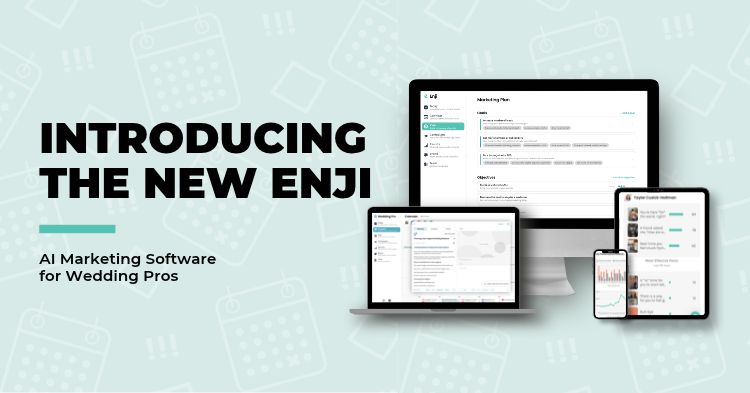
Enji's booking season campaign template lets you set these targets right in your plan and track how you're doing against them all season.
Set Up Simple Tracking Before the First Inquiry Arrives
Future you will be so grateful you spent half an hour on this now. You don't need a fancy dashboard. You need one simple system that keeps your numbers in one place.
Start with your inquiry form. Add a required "How did you hear about us?" question with set options, like:
- Referral
- Listing site
- Blog
- Other
That one small tweak turns every new inquiry into a data point. Over time, you'll see exactly which sources bring couples through the door.
Next, log your leads in Enji. Right at the top of your KPI dashboard, you’ll find Leads by Source, so where your inquiries come from is front and center every time you check your numbers. For now, you’ll add leads manually, but automatic tracking is on the way. Stay tuned!
Finally, schedule a monthly KPI day. Pick one day a month (we usually recommend the 1st!) to sit down with your numbers. Before your first one, make sure Google Analytics is installed and tracking your inquiry form submissions. Enji pulls in data from the tools you already use, like Google Analytics and Instagram, so your traffic, top-performing content and leads by source all live in one place. You’ll see what’s getting attention and what’s actually bringing in inquiries, without digging through five different tabs.
The Marketing Numbers to Track During Booking Season
Once inquiries start coming in, you don't need to track everything. You just need the handful of numbers that tell you whether you're on pace and where your marketing (or sales process) might be leaking.
Here are the big ones.
Inquiries per month
Compare how many inquiries you actually got to your monthly target (12, in our example). This one number tells you whether you're on track for your booking goal.
Why it matters: If you spot a shortfall in December, you still have time to fix it. Finding out in April just stings.
Inquiries by source
Use your "How did you hear about us?" answers and Enji’s Leads by Source chart to see how many inquiries each channel brought in: Instagram, Google, referrals, listing sites, and so on.
Why it matters: This is how you test your hypotheses. If you were sure Instagram was your best lead source but Google and referrals are doing the heavy lifting, now you know where to focus.
Inquiry-to-booking conversion rate
Booked clients ÷ total inquiries. Check it monthly if you can.
Why it matters: This shows whether your sales process is doing its job. If it's low, you might not need more inquiries at all. You might need a better follow-up sequence, clearer packages or a smoother booking process.
Traffic-to-inquiry conversion rate
Pick your main channel and see how much of its attention actually turns into inquiries. On your website, that’s inquiries as a share of monthly visitors. On Instagram, it’s inquiries from Instagram compared with profile visits or link-in-bio clicks.
Why it matters: If you've got plenty of eyeballs but very few inquiries, the path from your content to your inquiry form is probably broken somewhere.
Cost per lead (if you pay for ads, listing sites, or marketing help)
Divide your monthly spend on a channel by the number of inquiries it brought in.
Why it matters: A listing site that brings three solid leads for $50 is a better deal than one that brings 30 unqualified leads for $500. Knowing your cost per lead helps you decide with confidence what to renew or cancel.
Enji's KPI dashboard pulls a lot of this into one place for you, like website traffic, leads, and top-performing posts, so you're not constantly copying numbers into a spreadsheet.
How to Read Your Numbers Mid-Season
Knowing what to track is step one. Knowing what your numbers are actually trying to tell you? That's where things get good.
Here are a few common patterns and what they usually mean.
Low inquiries, healthy conversion
Inquiries are below target, but a solid share of them are turning into bookings. Good news: your process works. The problem is visibility. Turn up your top-of-funnel efforts with more content, stronger search visibility, or more listing or ad activity.
Plenty of inquiries, low conversion
Your inbox is buzzing, but your calendar isn’t filling up. Frustrating, right? The good news: you probably don’t need more inquiries. Your marketing is clearly doing its job. Something between ‘Hi, we love your work!’ and ‘Here’s our deposit’ just needs a little tune-up. Ask yourself:
- Is my pricing clear enough to attract couples in the right budget range?
- How fast am I replying?
- Does my first reply make booking a consultation easy and obvious?
- Does my consultation build trust and answer their concerns?
Lots of traffic, few inquiries
Google Analytics shows healthy traffic, but hardly anyone's reaching out. Your site is probably confusing or missing a clear next step. Check:
- Is your inquiry form easy to find?
- Are your calls to action specific, like "Check your date" instead of a generic "Contact"?
- Do you share enough pricing info for couples to feel confident reaching out?
One source brings lots of inquiries that rarely book
If one listing site or platform sends you a pile of inquiries that almost never convert, it may be attracting the wrong couples for your brand or price point. That doesn't automatically make it a bad source. Try adjusting your profile, imagery, or messaging, or decide it's not worth renewing.
And the golden rule: make one change at a time. If you overhaul your website, raise your prices, rewrite your emails, and launch three new ads all in the same week, it will be harder to tell what actually made the difference.
After Booking Season: The Debrief That Makes Next Year Easier
Booking season is finally winding down. Go ahead and take a breath (you earned it). But before you close the books on this one, know that your KPI dashboard and analytics are sitting on a goldmine of info. Now’s the time to turn all that tracking into smarter, easier decisions for next year.
Find your top-performing content. Pop into Google Analytics and look for the pages and posts that kept pulling in visitors on their own, no promo required. Those posts are basically your quiet little marketing interns, working away in the background while you were busy with clients. Give them some love: refresh them, turn them into social posts, or write new content on similar topics.
Compare lead sources by conversion rate, not just volume. The channel that sent the most inquiries isn’t always the one that sent the best ones. Which channels actually produced booked clients? Maybe referrals only trickle in, but they book at a much higher rate than Instagram or listing sites.
Figure out where leads went cold. Every ghosted inquiry left a little clue behind, so grab your magnifying glass and play detective for a minute. Look at the last thing each couple heard from you before they went quiet. Was it your first reply, the consultation, or the proposal and contract? Patch just one leaky spot, and next year’s bookings can get a very real bump.
Compare your results to your targets. Remember that easy math you did before the season? Time to see how it held up. Line up your monthly inquiries against your target, your real conversion rate against your guess, and your booked weddings against your goal.
Revisit your hypotheses. Okay, this is the fun part. Pull out those guesses you wrote down before the season and see which ones held up. Was Instagram really your best lead source, or did Google quietly steal the show? Did all that consistent blogging actually grow your traffic? Did lead quality improve? Jot down what you nailed, what totally surprised you, and what you’ll do differently next season.
And if the thought of hunting down all these numbers makes you want to crawl back under the covers, Enji’s KPI dashboard has your back. It pulls your website traffic, leads and top-performing posts into one place, with most of the numbers updating automatically.
Quick Reference Guide For Wedding Pros: What to Track and When
Here's your at-a-glance timeline.
Before booking season:
- Write down your hypotheses
- Set your booking and inquiry targets by working backward
- Add the "How did you hear about us?" question to your inquiry form
- Start logging your leads in Enji
- Confirm Google Analytics is tracking form submissions
Monthly during booking season (your KPI day):
- Inquiries vs. your monthly target
- Inquiries by source
- Inquiry-to-booking conversion rate
- Traffic-to-inquiry conversion rate
- Cost per lead for any paid channels
After booking season:
- Top-performing content
- Lead sources by conversion rate
- Where leads went cold
- Actual results vs. targets
- Which hypotheses were right, wrong, or surprising
The best part? You can absolutely run this whole system with a spreadsheet and a calendar reminder. Enji just takes a lot of the manual collecting and math off your plate, so you can spend your time acting on the numbers instead of wrangling them.
FAQ: Booking Season Numbers for Wedding Pros
What is a good inquiry-to-booking conversion rate for wedding pros?
There’s no one magic number, since it depends on your niche and price point. If you haven’t tracked yours yet, assume somewhere around 20–30% (25% is an easy middle), then replace it with your real number after a season. If your real rate comes in lower, take a look at your response time, how clear your pricing is, and how you handle consultations and follow-ups. If you're above it, amazing! Just double-check that you're not underpriced.
How many inquiries do I need to hit my booking goal?
Divide your booking goal by your conversion rate. If you want 20 weddings and convert 25% of inquiries, you'll need about 80 inquiries (20 ÷ 0.25 = 80). Don't know your conversion rate yet? Start with 20–30% as a working estimate and update it once you have real numbers.
What's the easiest way to track where wedding inquiries come from?
Make "How did you hear about us?" a required question on your inquiry form, with a few set choices like Instagram, Google, referral, listing site, Pinterest, and blog. That keeps your data clean and super easy to tally. Then log every inquiry’s source in Enji, where Leads by Source sits right at the top of your KPI dashboard, so you can spot patterns over time.
How often should I check my marketing numbers during booking season?
Once a month is plenty. Block off a KPI day to check whether inquiries are on pace, where they’re coming from, and how your conversion rates, traffic and cost per lead are trending. That rhythm keeps you in the know without turning analytics into a second full-time job.
What should I do if my inquiries are behind target?
Diagnose before you do anything drastic. Low inquiries but a strong conversion rate? You likely need more visibility: more content, stronger SEO, refreshed listing profiles or targeted ads. Low inquiries and shaky conversion? You may need more visibility and a tighter sales process. Either way, make one or two focused changes, then watch what happens over the next few weeks.
Stop Winging Booking Season
If you’re like most wedding pros, you love what you do. Heck, you probably even like the marketing part. What you don’t love? Spending every booking season crossing your fingers and hitting refresh on your inbox like it owes you money. So set your targets before the season starts, peek at a few key numbers while it runs, and debrief when it wraps. That’s how “I sure hope this works” turns into a system you can repeat (and keep making better) year after year.
And trust us, the payoff is real. You’ll know which channels bring you the right couples, how many inquiries you actually need, where leads have been sneaking out the back door, and exactly what’s worth doubling down on next year. No more guessing. No more “I think Instagram was good this year?”
That’s the kind of clarity Enji is built for, minus the 11 pm. spreadsheet sessions and the mystery formulas you copied from a YouTube tutorial. The KPI dashboard and booking season campaign template help you set your targets, track your results and see what’s working at a glance.
Ready to make this the last booking season you wing? Start your free 14-day trial of Enji and let your numbers do some of the heavy lifting for once.

Tayler Cusick Hollman
Founder of Enji | Small Business Marketing Strategist
Tayler Cusick Hollman is the co-founder of Enji, a marketing project management built specifically for small business owners who are doing it themselves. With 10+ years of experience in small business marketing, Tayler has helped thousands of founders create clear, repeatable marketing systems that drive consistency, visibility, and revenue—without relying on agencies or complicated tools.Her work focuses on creating realistic marketing plans, getting those plans done, and helping small business owners do the marketing that matters to them. Tayler’s framework and insights are used by entrepreneurs across industries to plan, do, and review their marketing with confidence.