The best way to market your wedding business for booking season is to start two months early instead of posting more once the rush hits. Your timeline has four phases. Foundation in September (about 6 hours): update your customer persona, pricing and website. Set Up in October (about 8 hours): gather reviews, refresh your top blog posts and plan your content. Execution from November through February: repeat a four-week content cycle each month. Debrief afterward: see what brought in your best leads. Already behind? Start with your inquiry form, your pricing, a few fresh reviews and one month of content.
You know engagement season is coming. You can practically already hear the Thanksgiving proposals, the Christmas morning "she said yes!" posts, and the New Year's Eve rings clinking against champagne flutes. And yet, somehow, every single year, a whole lot of wedding pros look up the week before Thanksgiving and think, "Oh no. Booking season. I should post more."
You would never plan a wedding that way. You don't show up six weeks before a 150-guest event and say, "Oh shoot, that snuck up on me, let's just wing it and hope for the best."
So why are you doing that with your marketing?
With over a decade’s worth of experience working closely with wedding pros, the mistake we see most is this: wedding pros start noticing booking season only once it's already started, then reacting by posting more. That's stressful twice over. It's stressful to create everything in the moment, and it's stressful because you're never quite sure it's working.
The pros who have the most successful (and least stressful) booking seasons do something different. They know that volume isn't the lever. Timing and message are.
So let's talk about how to run booking season in a way you control, without ending up totally frizzle-fried. Below, you'll get a four-phase marketing timeline that actually starts in September, how many hours each phase takes, and what to do if you're already behind.
In this post, we're sharing:
- Why getting strategic with your booking season marketing beats getting louder
- Phase 1: Foundation (September, about 6 hours)
- Phase 2: Set Up (October, about 8 hours) plus a catch-up plan if you're already behind
- Phase 3: Execution, including a four-week content calendar
- Phase 4: Debrief
- Your booking season timeline at a glance
- Answers to common booking season questions
Getting Louder vs. Getting Strategic with Your Wedding Business Marketing
Most wedding pros handle booking season the same way they handle a slow week on Instagram: they get louder.
Getting louder looks like posting more often, sharing every pretty photo from your last gallery, sprinkling in a "Now booking 2027!" graphic, and hoping something lands with the right couple at the right time. It feels like effort. It just isn't always effective.
Getting strategic looks different. It's less about shouting and more about saying the right things at the right time, guided by an actual plan. Instead of scrambling for something to post, you're walking couples down a clear path from "We just got engaged!" to "Okay, we're ready to inquire."
Because let's be real: couples aren't short on pretty photos. Their feeds are overflowing with bouquets, tablescapes, and veil shots. What they're short on is confidence. They're worried about making the wrong move, hiring the wrong vendor, blowing their budget or regretting a decision.
They don't need more noise. They just need to feel confident they’re booking the right wedding vendors.
And good news: you already know how to do this. You use a phased approach for every wedding you work on. You'd never book florals before the venue or send invitations before the guest list is locked. Your booking season marketing deserves that same project-manager brain: phases, dependencies, and a timeline that starts before the rush.
Phase 1: Foundation (Two Months Out, September, About 6 Hours)
Phase 1 is the work no one sees, but it makes everything after it easier and way more effective. Think of it as pre-production, the part that makes sure you're saying the right things to the right people before engagement season hits.
1. Update your customer persona (about 1 hour)
Your ideal couples change. Prices shift, trends come and go, and so do their worries and priorities. Before you start posting, take a fresh look at who you're actually talking to.
Ask yourself:
- What's motivating them to book right now?
- What are they struggling with in planning?
- What do they want from a vendor like you, emotionally and practically?
- What do they need to see and hear to feel confident reaching out?
Want a head start? Enji's free customer persona generator walks you through the questions and gives you a usable persona in about an hour. That one document becomes the lens for your content, your website copy, and your offers.
2. Update packages and pricing (about 1 hour)
Next, take a look at what you're actually selling. Do your packages match what your ideal couples want now, not three seasons ago? Did you notice upgrade patterns this year that should just become a standard package? Did certain offers never sell at all?
Use what you just learned from the season you wrapped:
- Which packages sold the most?
- Which ones were the most profitable?
- Where did you keep customizing the same add-ons over and over?
And while you're in there, sanity-check your pricing. Are you actually profitable at these rates once you factor in your time, costs, and taxes? A fully booked calendar at unprofitable rates isn't the win it looks like.
3. Brand and website audit (about 4 hours)
Now, pretend you're a newly engaged couple who just found you on Instagram. What happens next?
Walk through your brand and site with that lens:
- Are your visuals and messaging consistent across Instagram, your website, your Google listing, and any directories?
- Does your website speak directly to the ideal couple you just defined, using their words and addressing their worries?
- Is there some form of pricing information? Even a "starting at" rate or a range helps filter out misaligned inquiries and builds trust.
- Have you tested every link, form, and button, especially your inquiry form? Fill it out yourself. Does it work? Does the confirmation message make sense? Do you actually get the email?
Nobody throws you a parade for this phase. But it's the difference between "lots of clicks, no inquiries" and "they found me, loved me, and booked."
Phase 2: Set Up (One Month Out, October, About 8 Hours)
October is your setup month. Quick reality check: if you skipped Phase 1, this is where you start stacking about 14 hours of work into the busiest time of year. (And that's how marketing turns into panic instead of a plan.)
Assuming your foundation is in place, here's what's next.
1. Gather reviews
Skip the "Hey, can you leave me a review?" ask. Instead, give past couples better questions so their testimonials actually do some selling for you.
Try asking:
- What were you worried about before hiring a [planner/photographer/florist/etc.]?
- What made you feel confident choosing me?
- What surprised you most about working together?
Prompts like these turn "She was amazing!" into "We were nervous about planning from out of state, but she handled every detail and made it feel easy." Now that's a review that books clients.
While you're at it, ask a few of your most aligned couples if they'd share a short video or audio testimonial. Even a 30-second voice memo over wedding b-roll makes seriously strong social content, and you can reuse it everywhere.
2. Refresh your top blog posts
Instead of trying to write ten brand-new posts, give some love to what's already working.
- Check your analytics to find the posts that already bring in traffic.
- Expand them to around 1,000+ words so they're more helpful and more likely to rank.
- Add a TL;DR summary at the top for the skimmers.
- Add a short FAQ at the bottom with related questions your couples actually ask.
- Add relevant testimonials, real wedding examples, and internal links to other posts or your services page.
- Update the publish date and resubmit the page in Google Search Console so Google knows to re-crawl it.
This one's especially powerful for planners and photographers, since couples are quite literally Googling their way through every decision.
3. Plan your content calendar
This is where "I should post" turns into posts that actually go out.
Budget about an hour of planning for each month of booking season. Map out themes, not just individual posts: when you'll share real weddings, when you'll explain your process, when you'll build trust, and when you'll actually promote.
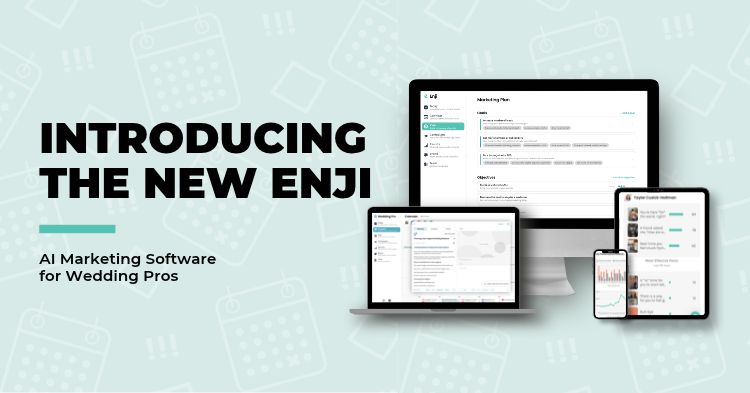
If you're using Enji, this is where the booking season campaign template really shines. It lays out what to say and when, and the AI Copywriter and Social Media Scheduler help you write and queue everything in your brand voice. That way you're not glued to your phone in December.
Already Behind? A Catch-Up Plan for Late October or November
If it's already late October or November as you're reading this, first: deep breath. Second: please don't try to cram all 14 hours into one weekend. That's a fast track to burnout.
Instead, prioritize like this:
- Test your inquiry form and website. Make sure everything works, and your messaging is clear.
- Add pricing information to your site. Starting rates or a range is plenty for now.
- Request 3–5 reviews using those better questions, so you've got fresh, specific testimonials.
- Plan your first month of content using a simple version of the four-week calendar below.
Then push the persona work and package updates to your slow season. Don't skip them! Just move them to a time when you can do them well and set yourself up properly for next year.
Phase 3: Execution (Engagement Season, November Through February)
Now we're in the thick of it. Engagement season is in full swing, and your marketing suddenly has a lot of jobs to do. Couples need to find you, get interested, and actually inquire. Posting more won't make that happen on its own. Your real job is to guide them through a simple journey: find you, feel seen by you, trust you, then reach out.
So let's think about it from the couple's side. Meet Alexis (she’s our hypothetical example). She just got engaged, and she's:
- Anxious about choosing the wrong vendor
- Reading Reddit threads and wedding forums full of horror stories
- Asking blunt, specific questions about budgets, red flags, and how to tell who's actually good
A caption that says "Loved this dreamy day" under a gorgeous flatlay doesn't answer any of that for Alexis. Even if you post it five times a week.
This is where a basic marketing funnel helps. In plain terms:
- Top of the funnel: Couples realize you exist. Your job is to entertain and inspire.
- Middle of the funnel: Couples check you out. Your job is to educate and build trust.
- Bottom of the funnel: Couples feel ready. Your job is to promote and clearly invite the inquiry.
Your secret weapon? Real questions from real couples. Turn them into posts, Reels, blogs, FAQs, and emails. "What should we book first?" "Can we do a first look if we're kind of traditional?" "Are we too late for a June date?" Content that answers questions like these builds more trust than a hundred aesthetic-only posts ever could.
The Four-Week Content Calendar (Repeat Each Month)
To keep execution simple, use a repeating four-week content cycle for each month of booking season. Every week has a job.
Week 1: "Realize you exist" Share real weddings and the stories behind them, some behind-the-scenes moments, and maybe a trends or "what's actually worth it" post. The goal is for couples to think, "Okay, this is my vibe. I'm in the right place."
Week 2: "Check you out." Let them meet you. Share your personality, your point of view, how you work with couples, and why you do things the way you do. People don't just hire "a photographer" or "a planner." They hire people. This week should leave couples feeling curious and connected.
Week 3: "Know, like and trust" Time for process and proof. Walk through your process step by step, talk about how you handle common hiccups, and weave reviews into your captions and Stories. You want couples to feel calm and reassured: "Okay, this isn't their first rodeo. We won't be the guinea pigs."
Week 4: "Promote" You've earned the right to ask for the sale. Share your availability, outline what's included in your most popular package, make "how to inquire" super clear, and invite them to reach out. A clear call to action doesn't make you pushy. It makes you helpful to the couples who are already leaning in.
Then repeat the cycle every month from November through February. This is the most formulaic version, so feel free to mix things up, as long as you cover all four jobs somewhere in each month.
A few ways to save your sanity:
- Repurpose across channels. Real weddings, your process, your point of view, and anything transparent all work as Instagram posts and blog posts (plus pins and emails, too).
- Stretch your testimonials. One video testimonial can become a Reel, a blog post, and a quote graphic.
- Let Enji do the heavy lifting. The booking season campaign template plugs these themes right onto your calendar. Then the AI Copywriter drafts the posts in your voice and the Social Media Scheduler handles publishing.
Phase 4: Debrief (After Booking Season)
This is the part almost everyone skips. Booking season slows down, and most pros just…move on. But the good stuff is in looking back.
Carve out a little time to ask:
- Where did your best leads actually come from? Instagram? Google? Pinterest? Referrals?
- Which posts got DMs, replies, or form fills?
- Where did couples drop off? Lots of profile visits but no site clicks? Lots of clicks but no inquiries?
Then write down what worked, what didn't, and what you'll do differently next year. It doesn't need to be a novel. Even one page of notes keeps you from starting from scratch next September.
If you're using Enji, the KPI dashboard is about to become your best friend. It pulls your traffic, leads, and top-performing posts into one place, so your debrief takes minutes instead of hours. And you get real data to shape next year's timeline.
Your Booking Season Timeline at a Glance
Here's the big picture:
- September: Foundation (about 6 hours). Customer persona, packages and pricing, plus a brand and website audit.
- October: Set Up (about 8 hours). Reviews, a blog refresh and your booking season content calendar.
- November-February: Execution. Run the four-week content cycle each month: realize you exist, check you out, know-like-trust, promote.
- After booking season: Debrief. Look at what actually drove inquiries and adjust your plan for next year.
And if your slow season isn't in the fall (hi, hot-climate and destination pros!), just shift the whole thing to match your own calendar. The structure stays the same even if the months change.
FAQ
When does wedding booking season start?
Booking season starts right on the heels of engagement season which starts in November. Inquiries usually begin trickling in during December, and the bulk of bookings land from January through May, as couples who got engaged over the holidays (through Valentine’s Day) compare and book vendors.
When is engagement season?
Engagement season typically runs from late November through mid-February, with big spikes around Thanksgiving, Christmas, New Year's Eve, and Valentine's Day.
How far in advance should wedding pros prepare for booking season?
Aim to start about two months before. For most pros, that means September for your foundation work and October for setup, so you're ready to roll when engagement season kicks off in late November.
What should I post during booking season to get more wedding inquiries?
Think in four jobs: content that helps couples realize you exist (real weddings, stories, behind the scenes), content that helps them check you out (your personality, beliefs and approach), content that builds trust (process breakdowns, FAQs, reviews), and content that clearly invites the inquiry (availability, how to book, what happens next).
Is it too late to prepare if it's already November?
Nope! Start with the basics: fix your website and inquiry form, add pricing info, request a handful of strong reviews, and plan one month of focused content. Then save the deeper work, like persona updates and package revamps, for your true slow season so you're miles ahead next year.
Booking Season Is Won in September and October
Booking season isn't something you notice in November and then chase with more posts. You win it in September and October, with a clear message, a realistic timeline, and content that actually answers the questions your couples are asking.
Volume isn't the lever. Timing and message are.
Want help turning all of this into an actual plan on your calendar (instead of a good intention buried in your notes app)? Enji's booking season campaign template lays out the phases and the four-week cycle for you. Pair it with the AI Copywriter and Social Media Scheduler to write, schedule, and measure everything in your brand voice, without living inside your phone all winter.
Ready to stop reacting to booking season and start running it? Start your free 14-day trial of Enji and set up your next booking season now, not the week before Thanksgiving.

Tayler Cusick Hollman
Founder of Enji | Small Business Marketing Strategist
Tayler Cusick Hollman is the co-founder of Enji, a marketing project management built specifically for small business owners who are doing it themselves. With 10+ years of experience in small business marketing, Tayler has helped thousands of founders create clear, repeatable marketing systems that drive consistency, visibility, and revenue—without relying on agencies or complicated tools.Her work focuses on creating realistic marketing plans, getting those plans done, and helping small business owners do the marketing that matters to them. Tayler’s framework and insights are used by entrepreneurs across industries to plan, do, and review their marketing with confidence.